Union Station is the main rail hub of Los Angeles and one of the most beautiful buildings in the city. It opened in 1939, the last of the great American union stations, and it still does the job it was built for. Every day, Metro trains, Metrolink commuter trains, Amtrak long-distance trains and the FlyAway bus to LAX all pass through. You do not need a ticket to walk in, and it is worth a stop even if you are not catching a train.
This guide covers the history, what to look for inside, where to eat, and how to use the station to get around.
A short history
Union Station brought together the passenger services of three railroads, the Southern Pacific, the Union Pacific and the Santa Fe, which had each run their own stations in Los Angeles. The new terminal opened in May 1939 on land next to the city’s historic Plaza, which meant part of the original Chinatown was cleared to make room for it.
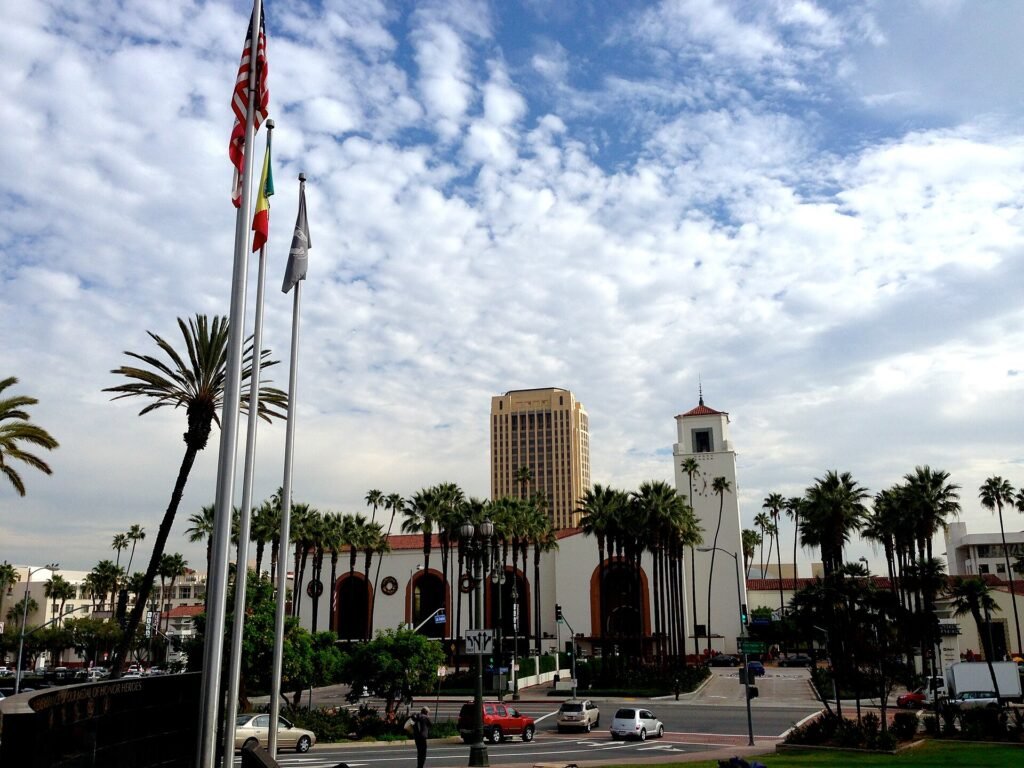
The building was designed by the father and son team John and Donald Parkinson, with other architects contributing. It blends Spanish Colonial and Mission Revival styles with Art Deco and Streamline Moderne details. The result looks distinctly Southern Californian: white stucco walls, a red tile roof, a tall clock tower and arched entrances, with sleek 1930s touches inside.
Passenger rail declined after World War II, and the station was quiet for decades. The opening of the Metro Red Line subway in 1993, followed by more rail lines and Metrolink service, brought crowds back. Union Station is listed on the National Register of Historic Places and is a Los Angeles Historic-Cultural Monument.
Inside the station

The waiting room
The main waiting room is the most photographed space. It has a high wood-beamed ceiling, tall arched windows, Art Deco chandeliers and rows of large leather armchairs. The floor is a patterned mix of marble and terra cotta tile. Some seating areas are reserved for ticketed passengers, so look for signs before you settle in.
The ticket concourse
The old ticket concourse, with its long wooden ticket counter, is no longer used for selling tickets. It now hosts events, exhibitions and screenings. When it is open to the public, it is worth a look for the woodwork and tile alone.
The former Fred Harvey restaurant
The station’s original restaurant was run by the Fred Harvey Company, famous for its dining rooms along the Santa Fe railroad. The space, with its tile floors and Art Deco design, now houses a brewery restaurant. Even if you do not eat there, step inside the doorway to see the room.
Film and TV
Union Station appears in many films, TV shows and commercials, often standing in for an airport, a police station or a government building. Ridley Scott used it in “Blade Runner.” If a shoot is underway, parts of the station may be closed off.
The courtyards

Two garden courtyards flank the waiting room. They are planted with trees and native and drought tolerant plants, with fountains and benches. On a sunny day they are a calm place to sit before a train. Look for the tiled walkways and the views of the clock tower.
The station hosts free events and art installations throughout the year, including music performances, which often take place in the courtyards or the concourse. Metro posts upcoming programs on the station’s website.
Tours
The Union Station website lists tours and events. Metro Art has offered free docent-led tours of the station’s art and architecture, and walking tour groups such as the Los Angeles Conservancy have led tours of the building. Schedules vary, so check ahead.
If you explore on your own, give yourself 30 to 45 minutes to see the waiting room, courtyards, concourse and front facade. Walk outside to Alameda Street to see the full front of the building with the clock tower.
Getting around from Union Station
Union Station is the most connected transit point in Los Angeles. From here you can catch:
- Metro B and D Lines (subway) to downtown, Koreatown and Hollywood.
- Metro A Line (light rail) to Pasadena, Little Tokyo and Long Beach.
- Metro J Line buses and many local bus routes from Patsaouras Transit Plaza on the east side.
- Metrolink commuter trains to Orange, Ventura, San Bernardino and Riverside counties and the Antelope Valley.
- Amtrak trains, including the Pacific Surfliner to San Diego and Santa Barbara and long-distance trains.
- FlyAway buses to LAX.
Our LA Metro guide explains fares and TAP cards, and our guide to getting from LAX to downtown Los Angeles compares the FlyAway with other options.
Day trips by train
Union Station is also the starting point for some of the easiest car-free day trips from Los Angeles. Amtrak’s Pacific Surfliner runs north along the coast to Ventura and Santa Barbara and south to San Juan Capistrano and San Diego. Many seats on the coastal stretches have ocean views, and the trains have a cafe car.
Metrolink trains reach towns such as Claremont, Orange, Ventura and San Juan Capistrano, though weekend service is thinner than weekday service. Check schedules both ways before you set out, and buy tickets in the official apps or at the station machines.
If you are taking an early train, the station has coffee and grab-and-go food in the concourse area. Arrive 15 to 20 minutes before departure to find your track, since signs list the platform shortly before boarding.
Eating at the station
Food options inside the station change over time, but expect a mix of grab-and-go counters, coffee and a few sit-down restaurants, including the brewery in the former Fred Harvey dining room. For a bigger meal, Olvera Street’s Mexican restaurants and taquerias are a two minute walk away, and Chinatown and Little Tokyo are one stop on the A Line.
What is nearby
Union Station is on the edge of downtown, and some of the city’s oldest places are a short walk away:
- Olvera Street and El Pueblo de Los Angeles are directly across Alameda Street. You can see the Avila Adobe, the Plaza and the market stalls. See our Olvera Street guide.
- Chinatown is a 10 to 15 minute walk north, or one stop on the A Line. Our Chinatown guide covers the Central Plaza and dim sum.
- Little Tokyo is one stop south on the A Line.
- Los Angeles City Hall and Grand Park are a short walk southwest.
Put together, Union Station, Olvera Street and Chinatown make an easy half day without a car.
Tips for visiting
- Watch your belongings. Like any busy transit hub, the station can be crowded.
- Photography is generally fine for personal use. Commercial shoots need a permit.
- Restrooms are available in the station, though locations can change during renovations.
- Parking is available in paid lots on the east side of the station.
- Visit in the morning for softer light in the waiting room and fewer crowds.
For more downtown sights, see our Los Angeles attractions hub.
Frequently asked questions
Is Union Station Los Angeles free to visit?
Yes. The waiting room, courtyards and public areas are free to enter. You only need a ticket to board a train or bus.
When was Union Station built?
It opened in May 1939. It was designed by John and Donald Parkinson.
What trains leave from Union Station?
Metro rail lines, Metrolink commuter trains, Amtrak trains including the Pacific Surfliner, and FlyAway buses to LAX all leave from Union Station.
What is near Union Station?
Olvera Street is across the street, Chinatown and Little Tokyo are one Metro stop away, and City Hall is a short walk.
Photo credits
Featured image: The front of Union Station on Alameda Street. ZhengZhou / CC BY-SA 3.0 via Wikimedia Commons.
Photo 1: The main waiting room at Union Station. Shesmax / CC BY-SA 4.0 via Wikimedia Commons.
Photo 2: Arches and palms at the entrance to Union Station. David Wilson from Oak Park, Illinois, USA / CC BY 2.0 via Wikimedia Commons.